
The Weekly Dispatch
Spaces Built for Listening

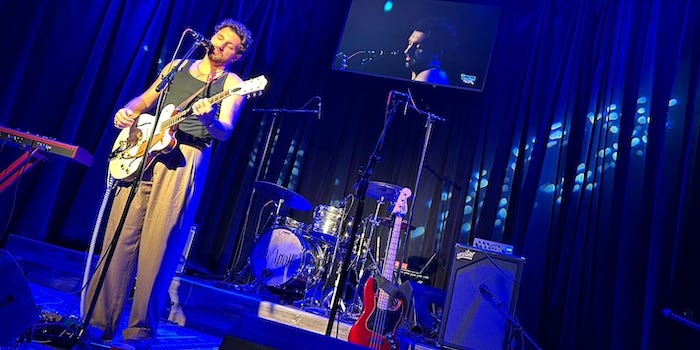
I’d just started college the first time I saw blues singer Lou Ann Barton. She walked onstage with a cigarette and had tousled hair like she’d just woken up and pantyhose that shimmered like an oil slick on a hot summer day. She stared down at the audience, took one last drag, and flicked it out over the dance floor.
I remember it happening in slow motion: the red ember rotating again and again. Conversations stopped mid-sentence. Glasses paused halfway to people’s lips. The moment it hit the middle of the floor the ember burst, the band kicked into a hard R&B groove, and away they went. The night no longer belonged to the club or the crowd. It belonged to her and the music.
I grew up in a small Texas town, and her show was my first experience like that.
I’ve been looking for more of those moments ever since: rooms where the music isn’t decoration but the only reason everyone showed up. The kinds of places where the second the band hits its stride, the crowd focuses on the stage because where else would its attention go?
I discovered shows like that are rarer than I thought.
Recently, I was talking with Texas Music Cafe founder Chris Ermoian about some college marketing interns he’d met. “They think,” he said, “that live music is something that costs $300 a ticket, a bottle of water is $18, and the PA at the far end of a football stadium blasting music sounds terrible.”
Or from another perspective, local musician and artist Mark Kieran talked to me last fall about playing bars and clubs in Waco when he was younger: “We’d be in the middle of a song, and the crowd would go wild, so you think, wow, we’re getting somewhere here. Then you look up and realize some team just scored on the TV mounted on the wall above the band.”
In a world full of distractions, some rooms still expect people to listen.
Even in a town that loves live music, those places are hard to maintain. Some nights the room fills up and everything clicks. Other nights, the same band that had the place buzzing a few weeks earlier is playing to four people talking over them at the bar.
The economics rarely scale the way bigger venues do. These smaller rooms are built on the idea that people are there to listen rather than wander in and out all night. That means the atmosphere can be electric when it works. It also means the margin for error is thin.
Texas Music Cafe is the best example of listening room culture in Waco. All the seats face the stage. When the music starts, everyone—or almost everyone—stops talking to watch the performance. The music is curated based on quality first, whether you’ve heard of the band or not. From LA’s The Mexican Standoff to local musician Sherman Ayres to the ongoing Thursday night songwriter series, identifying genre is often just a matter of your best guess. After Hamell on Trial played last year, I told one of the crew members I had no idea how to describe what we’d just seen.
He smiled and said, “I call it awesome.”
Every once in a while, a room still catches fire the way it did when I saw Lou Ann Barton flick her cigarette onto the dance floor. I felt it again last fall, watching Lew Apollo play a set of neo–soul songs in Waco. The music takes hold, the room turns toward it, and while it lasts, nothing else matters.
In a culture overrun by competing diversions, attention may be the rarest cultural resource. The places that matter are the ones that still know how to gather it.
SHOUT! Black Gospel Music Moments 500th Episode Celebration
For 500 episodes, the weekly KWBU segment SHOUT! Black Gospel Music Moments has introduced listeners to recordings drawn from Baylor University’s Black Gospel Music Preservation Project. Hosted by long-time Baylor professor Robert Darden, each episode pairs archival gospel recordings with stories about the people and traditions behind them, focusing on the “Golden Age of Gospel” from roughly 1945 to 1975.
This celebration at Moody Memorial Library on Sunday afternoon also points back to the larger effort behind it: the ongoing work of locating fragile recordings and digitizing them so the music can circulate again. Gospel music helped shape much of American popular music, yet many of its original recordings have nearly disappeared. Projects like this ensure that the sound—and the history carried inside it—remains audible.
Free tickets available online.
DJ Precyse
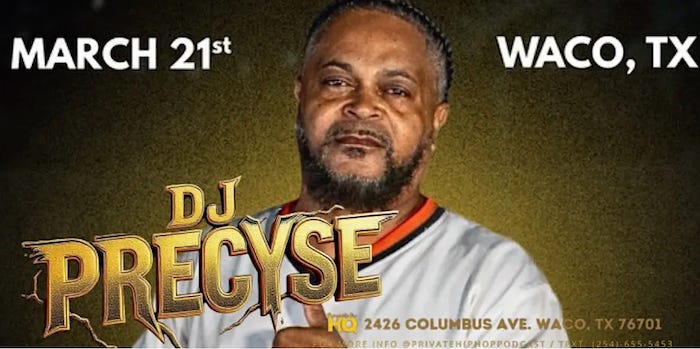
Central Texas DJ Devin Patton—better known as DJ Precyse—takes the stage for a headline set on Saturday, March 21, at the Private Hip-Hop HQ. Known locally for years behind the turntables and on radio—including a long run on The Beat, the Central Texas hip-hop station now broadcasting on 107.3—he’s become a familiar figure in Central Texas.
The venue itself is part of a larger story. The Private Hip-Hop HQ, built by local musician and producer Pirscription, is a creative hub for Waco’s hip-hop community, hosting shows while also supporting recording and media production. Music scenes don’t appear all at once; they grow around places like this.
Mics with Benefits
Mics With Benefits returns to the Hippodrome Theatre on the last Wednesday of the month, offering local musicians a chance to step on stage and test original material in front of a live audience. Performers sign up at the door and are drawn at random for the evening’s lineup, each playing two songs before a panel of working musicians and industry professionals who offer feedback. The performances are recorded and later released through the project’s podcast and video channels, giving artists a polished record of their work to use for promotion.
Co-founder Zachary Hill has become one of the behind-the-scenes forces in Waco’s music scene, promoting shows across social media and maintaining the We Promote Waco Facebook group where artists can share information about upcoming gigs. Efforts like his rarely make headlines, but they help keep a local music community visible and connected.
Free to attend and participate.

East Waco’s Tiniest Art Market
A repurposed vending machine at Revival Eastside Eatery quietly offers a different path for art to move through the city. One purchase leads to an unexpected connection that reveals how creative communities often operate through chance encounters rather than formal venues.
This episode of Your Waco Weekend examines how the distance between artist and audience can be far smaller than it first appears.
Coming Next Week
Printmaking, handmade books, and public art appearing at unexpected street corners demonstrate different paths into the act of making things with your own hands. Taken together, they suggest that creativity in this city isn’t confined to galleries—it shows up wherever people decide to participate.
Want to know more? Waco Insider is on Facebook and Instagram.
You might take a look at the calendars put together by Waco Wise, the Wacoan, or destinationwaco.org.
Is there another route to getting a list events for the weekend?