
The Weekly Dispatch
It Takes Forever to Build a City

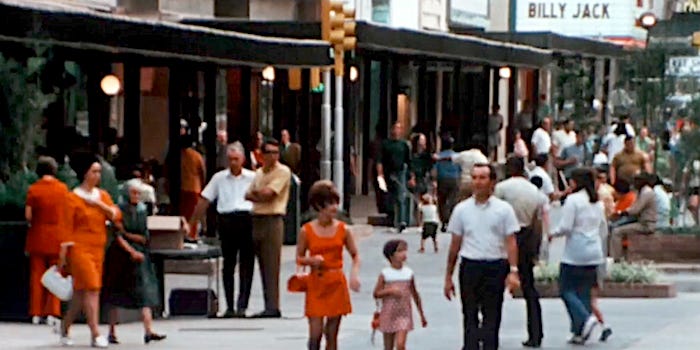
I wasn’t sure what to expect when I clicked the YouTube play button for the 1971 film about Waco’s Austin Avenue pedestrian mall project. The narrator begins by diagnosing downtown Waco. It’s described as a patient in distress, suffering from the effects of suburban growth, changing shopping habits, and years of neglect.
Then comes the cure.
Urban renewal is presented as “heroic medicine.” The pedestrian mall, which ran from 3rd to 9th Street, becomes a “heart transplant” for the city’s core. The narrator describes a downtown transformed by fountains, landscaping, shade trees, electric trams, and public gathering spaces. What had once been a struggling business district is now “alive and well again.” The language is striking not because it’s optimistic but because it’s absolute.
That’s what makes the film fascinating more than fifty years later. Nobody says they “hope” the project succeeds. Nobody says they “think” it will work. They just know.
“The dream came true,” the narrator declares at the end. “This experiment in change has been successful.”
The patient survived. Victory is declared on dedication day before the stitches have even had a chance to heal.
Reality, however, proved less interested in tidy story arcs. The pedestrian mall eventually disappeared by the late 1980s, and Austin Avenue reopened to traffic.
The first time I came to Waco was in the mid-‘90s for an academic conference at the Waco Convention Center. Everybody stayed next door at the Hilton, and the only nearby restaurant was Buzzard Billy’s on an opposite corner from the hotel on University Parks Drive. As I drove around downtown during the couple of days I was there, one closed storefront after another surrounded by empty parking spaces made me feel like I was in a dying Rust Belt city as opposed to Central Texas.
Not a lot had changed by 2007 when Chris McGowan moved to Waco to originally work as a planner for the Greater Waco Chamber of Commerce.
As he told me a couple of weeks ago, “One day I set out on foot to meet the business owners and was literally the only person walking up and down Austin Avenue.”
Today, a collection of restaurants and stores—from Ninfa’s to Spice Village to Cricket’s—fills the complex across Franklin Avenue from the Hilton. The Waco Hippodrome Theatre hosts a steady stream of touring music and comedy acts. Southern Roots Brewing Company bustles on weekends, and multiple venues present live local music.
My question for McGowan was simple: Why? What changed between the empty downtown he encountered in 2007 and the one that exists today? Was it deliberate planning? Magnolia? Broader economic trends?
“It’s hard to say,” he admitted.
At first, he described downtown’s revival as the result of multiple forces: city policies, private investment, Magnolia, and the wider growth reshaping Texas. But as our conversation continued, he kept looping back to the same idea. While planning documents, incentives, and physical projects mattered, people mattered even more.
“Places don’t make places,” he told me. “People make places.”
The pedestrian mall film celebrates fountains, landscaping, and electric trams. McGowan kept returning to something less tangible, describing downtown as “everybody’s neighborhood,” a place for the entire community rather than the residents of any one part of town.
That’s a different way of thinking about success than the one presented in the pedestrian mall film. Its narrator measures success through physical improvements and commercial activity. McGowan’s measure is simpler: Are people there? Are they spending time together?
“People being around other people is a really important part of what makes us human,” he said.
The challenge is that nobody can manufacture community the way they install a fountain.
“As a planner,” McGowan said, “I know where a sidewalk should go and what it should look like and how it should interface with the buildings next to it. Or what makes a good park or how to orient a building to make it more successful. But without people, all of that is kind of pointless, right?”
Still, I asked McGowan whether there were actually two downtowns now: one used by locals during the week and another shaped by the weekend tourist economy surrounding Magnolia.
“It’s interesting,” he said. “I don’t disagree with you.”
That wasn’t the response I expected.
Yet he resisted treating the distinction as a crisis. He emphasized that downtown succeeds when people choose to spend time there, whether they are local residents, tourists, or “everything in between.” But he also made something less romantic equally clear: Cities need revenue.
Restaurants, hotels, retail shops, and visitors generate revenue for the tax base that helps fund everything from streets to public safety.
So maybe there are two downtowns. Maybe there are twenty. The downtown remembered by the people who shopped at Woolworth’s in the 1950s isn’t the downtown I saw in the 1990s, and the one McGowan walked through in 2007 isn’t the place Magnolia visitors encounter today. Each generation inherits a different version of the same place and argues about what it should become next.
As McGowan put it, “It takes forever to build a city.”
Watching the pedestrian mall film now, the strangest thing isn’t that it disappeared. It’s that anyone could be certain about how downtown Waco would look ten, fifteen, or fifty years later. The planners and the developers couldn’t. Not Magnolia nor McGowan. Neither can I. Cities have a way of becoming something other than what anybody intended.
Filmage: The Story of Descendents/ALL
During Van Halen’s heyday in the early 1980s, lead singer David Lee Roth once joked, “At most jobs, they say, ‘Here today, gone tomorrow.’ In rock and roll, we say, ‘Here today, gone later today.’” And that’s the storyline behind most VH1 Behind the Music documentaries: discovery, success, conflict, collapse. But not every band moves in a straight line.
The documentary Filmage: The Story of Descendents/ALL is not about a Southern California punk band burning bright and disappearing. Instead, it’s about a group of musicians who kept finding their way back to one another thanks to a decades-long connection stronger than anyone expected.
Screening on Friday night, June 5, at Texas Music Cafe, Filmage traces the history of Descendents, whose fingerprints are all over modern punk rock. Producer Justin Wilson and co-director Matt Riggle will be on hand for a post-film Q&A exploring Descendents’ unusual journey through breakups, reunions, day jobs, raising kids, and decades of influence. No Descendents? No Green Day as we know them—and probably no pop-punk boom of the 1990s either.
The Dark Overlords of Waco
Five years ago, I made my first trip to Skellington Curiosities, when it was still in the Bosque Square Shopping Center next to a Jazzercize studio. The taxidermy, oddities, and Halloween aesthetics were easy enough to understand. The harder question was whether any of it would last. Plenty of scenes flare up around a charismatic personality or a clever idea, only to quietly disappear a short time later.
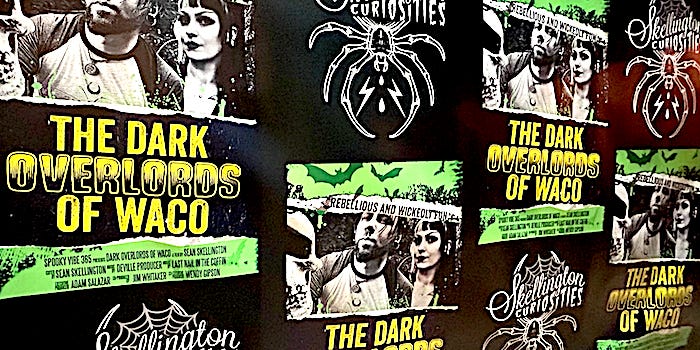
Back then, I thought this could go either way, especially given how far outside mainstream Waco life it operated. Then came The Dark Overlords of Waco, a documentary about Sean and Kylie Skellington released earlier this year that serves as evidence something more durable than I realized was taking shape.
Reactions to the Skellingtons in the documentary vary. One woman declares, “They’re weirdos!” while another guy says, “They’re the people that you think you should probably cross the street when you see them. But don’t, because they’re awesome!” The further the film goes, however, the less it’s about Sean and Kylie themselves and more about the network of relationships they’ve built in Waco. From Halloween balls to monthly markets and burlesque shows to local rivalries, the result is a snapshot of a subculture preserving its own story rather than waiting for someone else to tell it.
The Baylor Libraries YouTube Channel
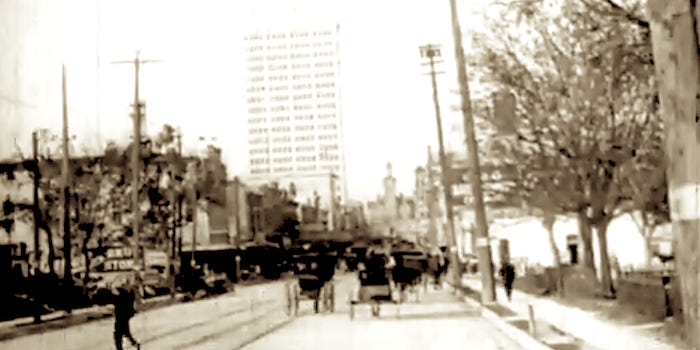
Earlier this year, I went looking online for an old silent film shot in Waco over a hundred years ago. I fell into the Baylor Libraries YouTube channel and emerged several hours later somewhere between the 1953 tornado, Baylor student life in the 1970s, and long-forgotten slices of everyday Central Texas history.
That’s the thing about archives: you rarely find only what you’re looking for. More often, one story leads to another until the past starts feeling less like a collection of facts and more like a place you can wander around.
The channel itself is the digital equivalent of being handed the keys to a giant attic full of boxes with God knows what in them. Most of the videos have only a few hundred views, and some barely crack double digits despite containing footage that exists nowhere else online. A few come with detailed notes explaining what you’re seeing. Others offer little more than a title and a date, leaving viewers to piece together the story for themselves. The result is a mishmash of clues rather than conclusions, preserving pieces of everyday life that would otherwise have disappeared.

“Whistlin’ is a Young Man’s Game”
Darrell “D-Rail” Ray has been a constant in Waco’s live music scene for decades. Week after week, he’s always playing somewhere, often with his schedule posted months in advance, while everybody else is still figuring out next weekend.
🎧 This ten-minute episode of Your Waco Weekend looks at D-Rail’s thirty-plus years of making a living one gig at a time. Along the way, he's built an eclectic repertoire, helped support other musicians, and once played a four-hour show for an audience of exactly one cat.
Open in Spotify or listen on other podcast platforms.
Subscribe to Your Waco Weekend wherever you get your podcasts—ten minutes, one story.
Coming Next Week
The Weekly Dispatch examines the realities of making music for a living, along with a tour through three very different ways live music shows up in Central Texas. From an intimate listening-room performance to an old-school variety entertainment show and a free summer concert series, they’re a reminder that music scenes aren’t products—they’re something people build together over time.
Great read, Loved the conversation! Inspired me to write a companion piece...
Great article. Having only lived in the Waco area for the last 9 years, your insights help me try to make sense of this area and its people. Looking forward to the next installment.