
The Weekly Dispatch
The Architecture of Community

The Weekly Dispatch has a new format. First, the case for the structures that make community possible. Then, three featured Waco events and the weekly podcast episode.
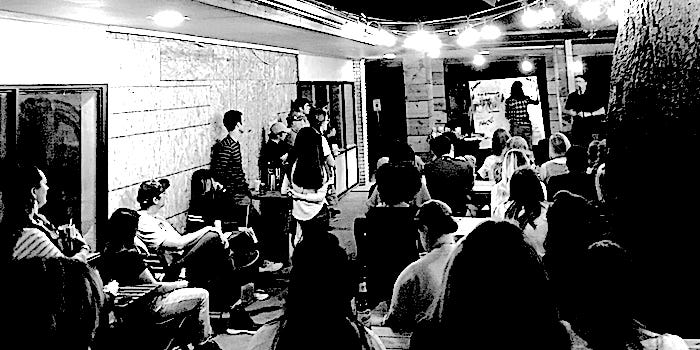
A night of Hispanic stories at the South Waco Community Center is fully booked almost a month in advance. Not a concert or a festival. No spectacle. Just chairs arranged around tables where people share a meal and talk.
That’s more than novelty. It’s demand.
In a city with plenty of entertainment options—from Magnolia Market at The Silos to The Backyard Bar Stage and Grill to the Extraco Events Center—some of the fastest-filling rooms are ones built for attention rather than the distraction of digital feeds. The question isn’t whether Waco has things to do. It’s why the rooms that require active listening and patience are filling up first.
This signal isn’t about programming but preference, as people choose gatherings over screens.
That choice has consequences. It limits scale and demands attention. It resists the frictionless spread that algorithms reward. What’s emerging in Waco isn’t a trend so much as an appetite because community is not a mood.
It is an architecture.
This demands rooms, schedules, moderators, tables, and shared expectations. It depends on structures strong enough to hold disagreement without collapsing into rancor.
One sold-out storytelling night could be wishful thinking about Waco’s civic life, but this pattern isn’t confined to one event.
It’s infrastructure revealing itself.
Public memory, work, and identity are being examined in spaces that require people to sit across from one another. At Barnett’s Whiskey House, locals gather for a sold-out night of “social studies” about Waco’s past 50, 100, and 150 years. Local creatives meet face-to-face at The Performing Arts Community Center, and a morning of “women, wisdom, and coffee networking” unfolds at Bitty & Beau’s Coffee.
Civic life is being pulled back into physical spaces.
That shift changes tone. Digital space rewards scale and speed. Physical space rewards attention and consequence. Online, expanding reach can feel like progress. In a room, depth is harder to fake. Someone at a town hall meeting asks, “Why this data center here now?” or “What does this development plan really mean?” The answers require accountability instead of amplification.
That’s the difference between turnout and trust. A city can fill seats at a public forum and still avoid its hardest arguments.
Waco is not abandoning growth. It is testing whether growth can survive our proximity to each other.
This is not unique to Waco. Across the country, small and mid-sized cities are rediscovering something growth alone cannot provide: institutions that hold complexity in public.
After two decades of building digital lives, people are competing for physical rooms again. Libraries are hosting civic dialogues that once lived online. Universities are reopening space for contested ideas to be argued face-to-face. Entrepreneurial ecosystems are testing plans in workshops rather than pitch decks alone. Arts institutions are structuring participation instead of performance.
Durable public spaces and systems are slow work, but cities that invest in that kind of architecture shape more than their skyline. They shape the terms under which their future is argued.
Waco is not an exception. It is evidence.
StartUp Waco’s Launchpad
Startup Waco’s Launchpad runs March 11–13 with a simple premise: business ideas are easy to have but hard to build. Over the course of three days, participants move from concept to structure—testing assumptions, forming teams, working with mentors, and shaping something that can survive contact with the real world. It’s free, which lowers the barrier. The work itself remains work.
By Friday afternoon, the pitch competition for funding isn’t about inspiration. It’s about clarity—what problem a solution solves, who it serves, and how the business sustains itself. Most ideas never make that leap, and opportunities like this exist to see which ones might. In a city that often talks about development, Launchpad is one of the places where growth is forced to define itself.
The Waco History Podcast: Celebrating 175 Years
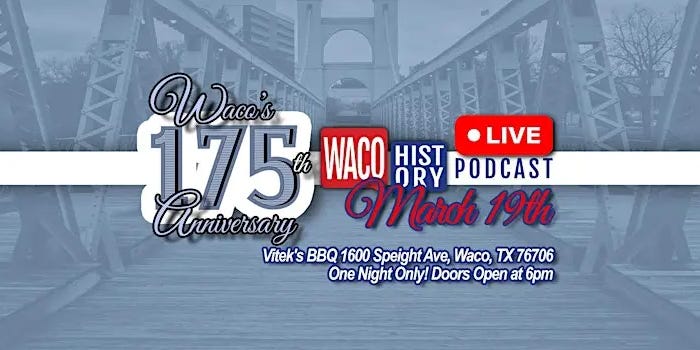
The Waco History Podcast goes live at Vitek’s for one night on March 19, marking the city’s 175th year not with a press release but with conversation. The room won’t be a studio—it’s a barbecue joint with trays sliding across tables and the low hum of people settling in for dinner. Stephen Sloan and Rick Tullis will take the mic in front of a crowd that can laugh or lean forward. History, in that setting, stops being archival and becomes social again.
A live taping alters the center of gravity. A podcast usually travels through earbuds and algorithms. Here, it runs through an audience. Tickets include dinner, trivia, and the kind of back-and-forth that rarely survives editing.
Baylor Libraries Author Series: Society Without People
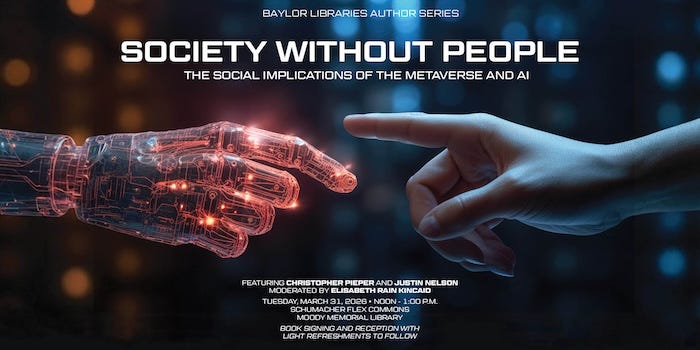
On March 31, the Baylor Libraries Author Series returns to Moody Memorial Library to examine a blunt proposition: what happens when social life drifts into systems built without bodies at the center? Society Without People, co-authored by sociologists Christopher Pieper and Justin Nelson, investigates how generative AI and the Metaverse are restructuring the ways identity is formed and authority is exercised. The argument is not about gadgets. It’s about governance—who designs the rules of digital space and what those rules quietly reward.
The conversation will unfold in a room full of people confronting a book that questions whether society can survive abstraction, tracing how code quietly reorganizes social life. That tension matters locally as much as nationally. Cities like Waco are not insulated from algorithmic systems; they are already shaped by them. Discussing that reality face-to-face keeps the conversation human.
Attend in person for free or register for the Zoom livestream.

When Crowd Size Becomes the Verdict
One night in Waco, an out-of-town neo-soul band plays to a near-empty room. Another night, a packed house listens to hill country blues, bodies pressed close to the stage. Same city. Same venue. Different stories we tell about what it meant.
This episode of Your Waco Weekend looks at what happens when turnout becomes a filter—and how that shapes what gets amplified, what gets ignored, and what a city decides is worth its attention.
Coming Next Week
A songwriter showcase, a gospel music celebration, a touring band, a late-night DJ set. Different rooms. Different audiences. Different traditions. Taken together, they say this about the city right now: people are showing up to listen.
Want to know more? Visit Waco Insider on Facebook and Instagram.